

Empty legs are truly complicated in private aviation. While not a scam, they are part of a complex operational ecosystem that make them hard to secure. They are often discounted relative to a normal On-Demand Charter, but they do carry a certain degree of cancellation risk depending on whether they are a "Fixed Empty Leg" or "Dynamic Empty Leg".
Most people would explain empty legs as being a repositioning flight. A jet needs to move from Point A to Point B to either pick up its next paying passenger or return to its home base, and that you depend entirely on someone else's schedule. While correct, there's more to that.
Let us explain.
The Two Types of Empty Legs: Dynamic vs. Fixed
One of the biggest mistakes customers and new brokers make is treating every empty leg as equal. From an operational standpoint, there are two distinct categories, and the difference between them can determine whether your trip is a success or a total logistics failure.
The "Dynamic" Empty Leg = High Risk
A Dynamic Empty Leg is an aircraft repositioning flight that is advertised before the primary client’s flight has taken place. This is where the highest level of cancellation risk resides.
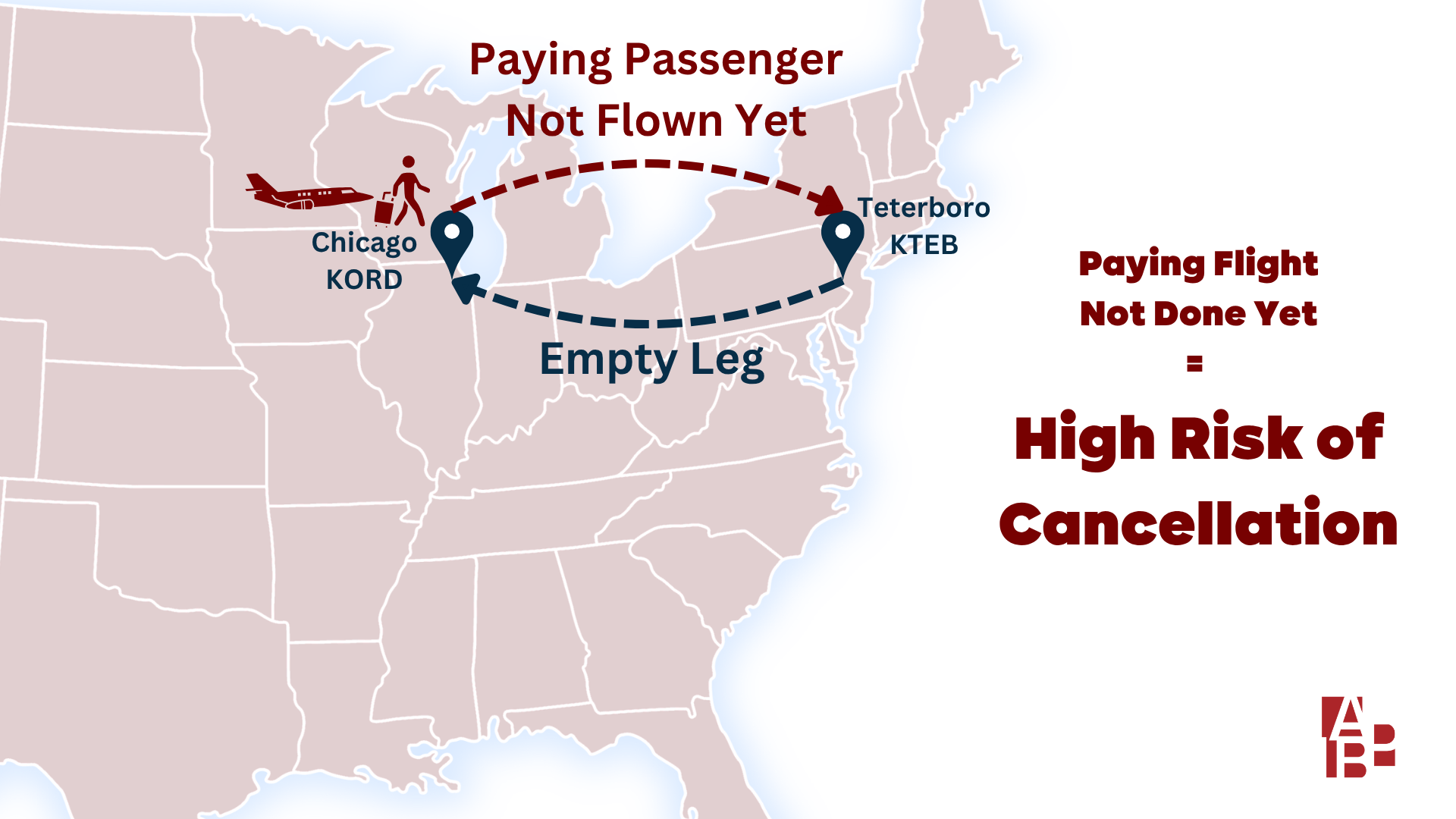
The only reason the plane is flying to pick you up is that a different client is paying to fly somewhere. Your entire flight is dependent on that original client's plans remaining exactly as they are.
Imagine an operator has a jet based in Chicago (KORD) that needs to fly to Teterboro (KTEB) to drop off a paying passenger (Red Dotted Line). This creates an empty leg flight on the return flight to KORD because the jet has to come back to base once the mission is complete. The operator advertises the empty leg from KTEB to KORD.
You book that empty leg. But a few hours before departure, the original client decides they no longer want to travel, therefore the jet no longer needs to go to Teterboro altogether. Because your flight was a "dynamic" repositioning for that specific client, your trip simply doesn't exist anymore.
In this scenario, although you'll probably get your refund, you have no other recourse. You are grounded, and because it’s a dynamic empty leg, the operator is under no obligation to find you a replacement aircraft at the same price.
The "Fixed" Empty Leg = Low Risk
A Fixed Empty Leg occurs when the primary client’s flight has already been completed. The plane is already at your departure point (in this case KTEB), and it simply needs to return home in KORD.
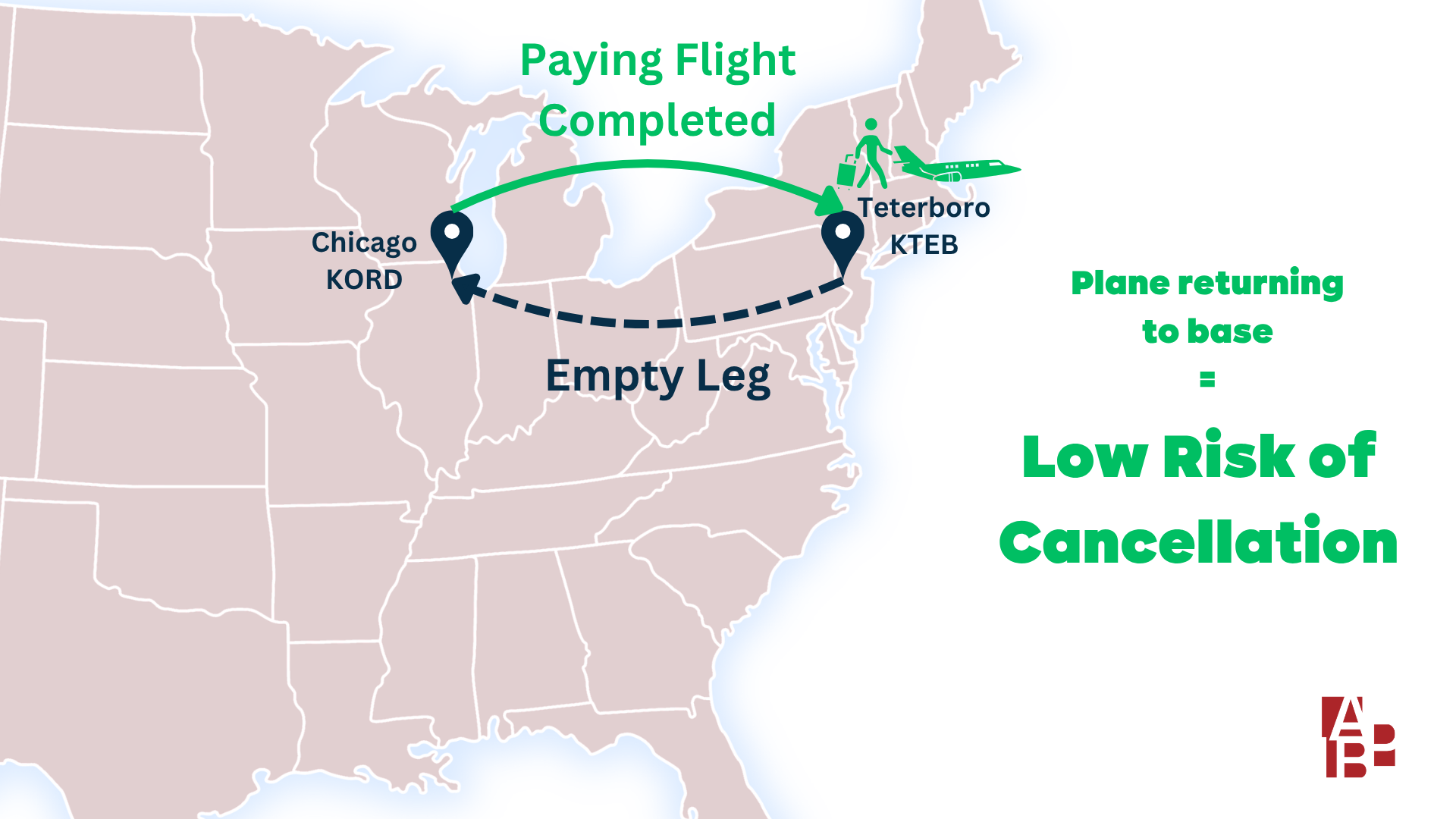
In this example, the jet has already dropped off the original client in Teterboro. The plane is now sitting on the tarmac in Teterboro, and is awaiting its next client to fly back to its home base in Chicago.
Because the "original" flight has already happened, the risk of cancellation is significantly lower, as it does not depend on the original client anymore.
The plane is physically there in Teterboro. Unless there is a mechanical failure, that plane is going back to Chicago. For a traveler, this is the version of an empty leg that is actually worth booking. It provides the discount without the "house of cards" instability of the dynamic model.
How do I know which type of empty leg it is?
Short answer: Ask the operator. Any operator should and will be able to share with you the circumstances of the empty leg. However, keep in mind that most operators won't mention any of these details unless otherwise asked. So if you're dealing with a client who you know is strict on schedule, make sure to ask about the circumstances surrounding the empty leg.
Are Empty Legs Really Discounted?
Technically, yes. In reality, No.
Let’s look at the math, because this is where the industry's vocabulary and technical realities often clash with public perception.
Let's start off by explaining that a standard private jet charter doesn't just charge you for the time you are in the air. If you book a one-way flight, the operator usually quotes you for the "round trip" to cover the cost of getting the plane back to its base, especially if they are what's called a "Base-to-Base Operator".
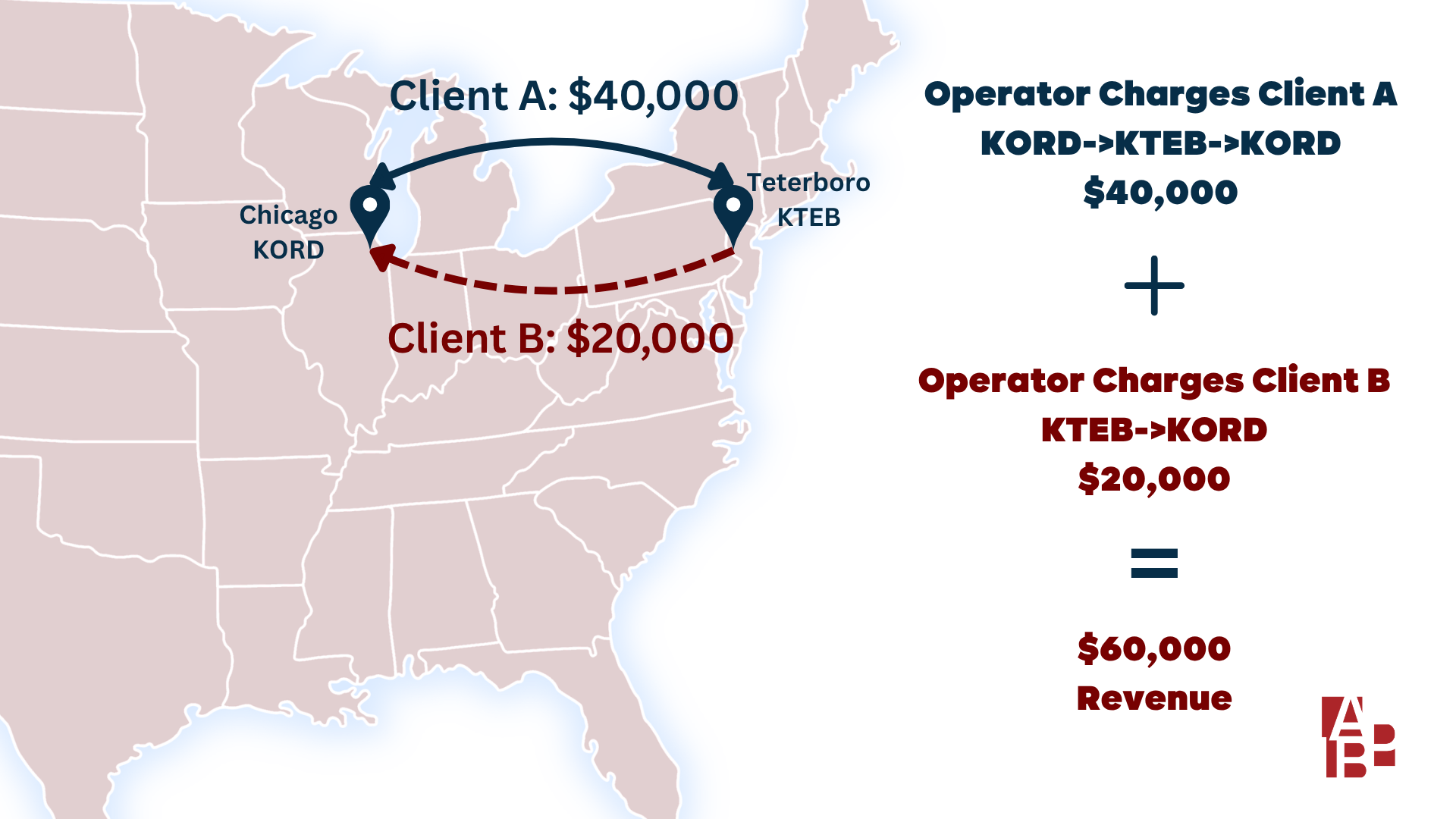
Let's look at that same passenger (Client A) who wants to fly from Chicago to Teterboro. Once dropping him off, the jet has to return back to base, thus creating an empty leg on the return flight. An operator might quote $40,000 for client A. That $40,000 covers the revenue flight to Teterboro, and the empty flight back to base in Chicago.
The operator sells that return flight back to Chicago as an empty leg for $20,000, or a "50% discount." Client B books it.
The discount is real, but:
You are still paying the full hourly rate. In this case, the $20,000 one-way flight is often the actual operational cost plus a margin for that specific leg. You aren't getting "half-off" the flight's value; you are just paying for the half that was previously bundled into someone else's bill.
The Operator is "Double-Dipping." In this case, the first client already paid for that return leg as part of their $40,000 quote. By selling it to you for an additional $20,000, the operator is effectively making $60,000 on a $40,000 operation.
This isn't necessarily a bad thing, it's how the business stays profitable and is actually smart, but as a buyer, you should realize that you are paying full price for a service that has already been subsidized by someone else.
So how do you find these empty legs?
There is no single source of empty legs because every operator is responsible for advertising their own empty flights, and not all of them go the extra mile in posting the flight beyond simply their own website. Here are some of the best places to find them:
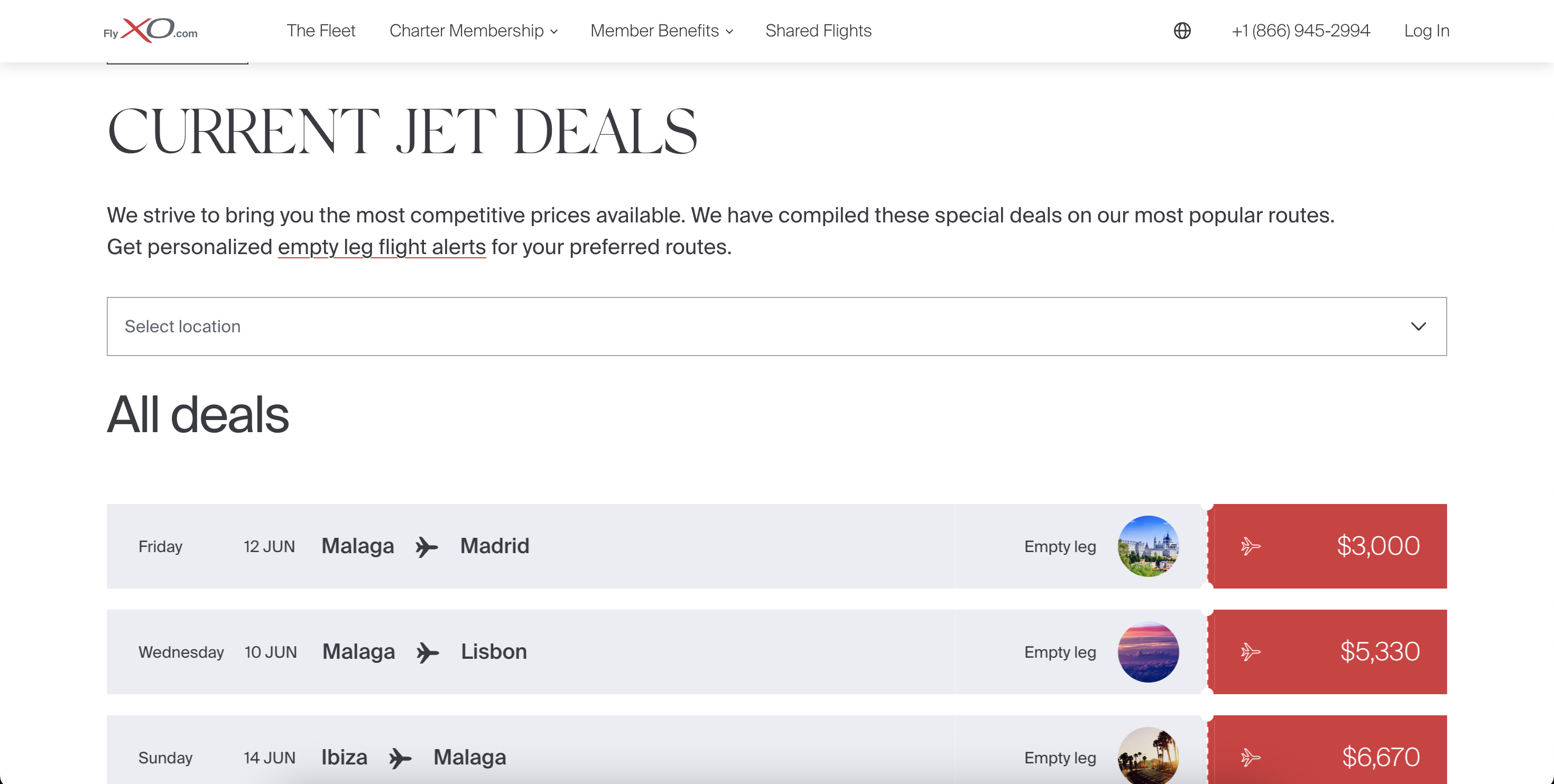
XOJets.com: Subsidiary company of Vista Jet, XO offers a convenient app with a list of internal empty legs. The list is updated daily, and offers the ability to set alerts on your preferred route.
Jets & Partners: Their system is powered by one of the big jet sourcing systems, Fly Easy, and they have a dedicated page to search for empty legs based on date and radius. You can also set alerts to received notifications on selected routes.
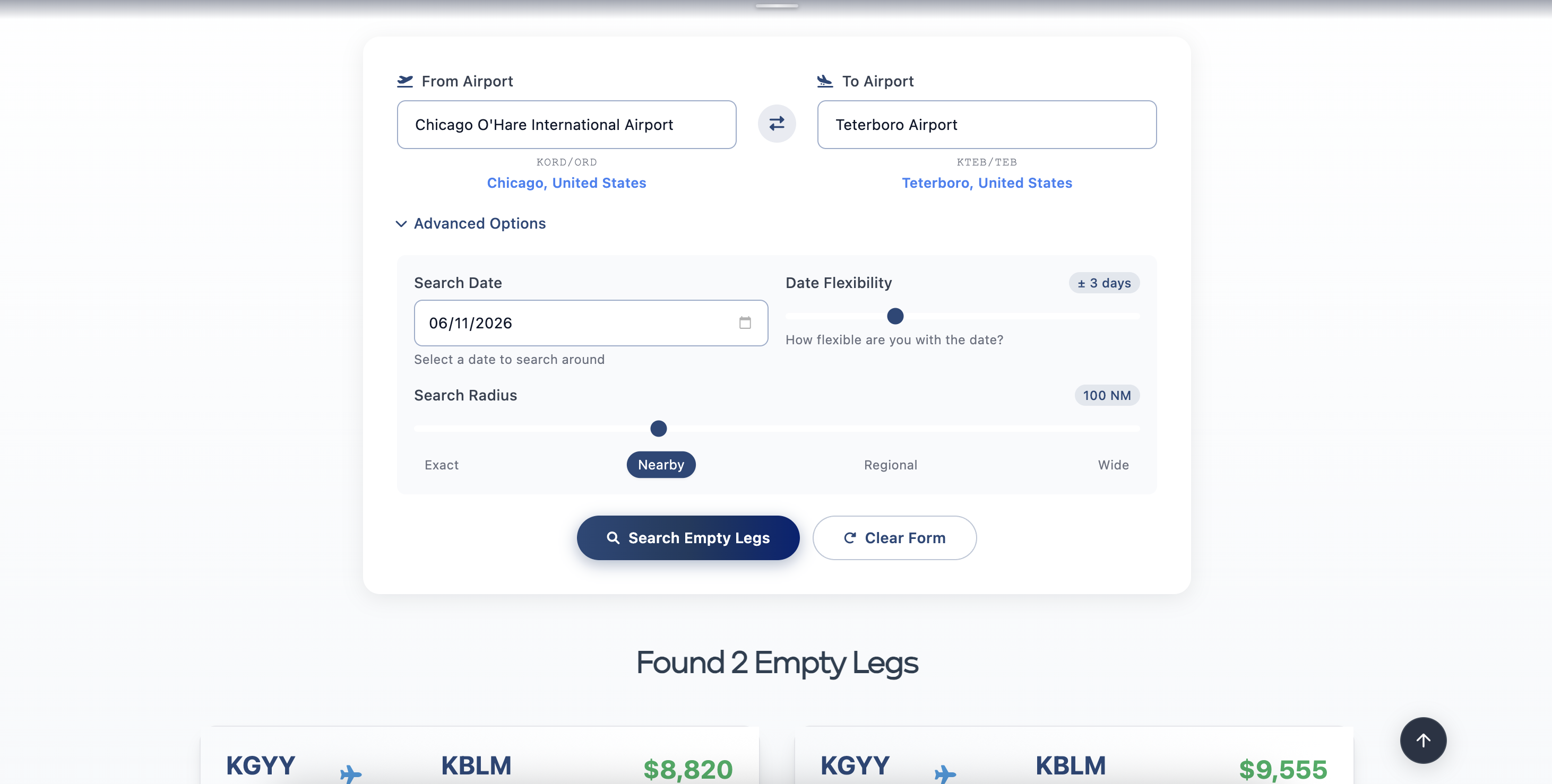
Jettly: One of the largest public databases of empty legs, Jettly lets you search thousands of repositioning flights by departure airport, destination, date, and passenger count. You can also sign up for email alerts to be notified when new empty legs matching your preferred routes become available.
FlyVictor: FlyVictor offers a global marketplace of empty legs with hundreds of available flights updated in real time. Its search tool allows you to filter by route and date, while registered users can create custom alerts to receive notifications when matching empty legs are listed.
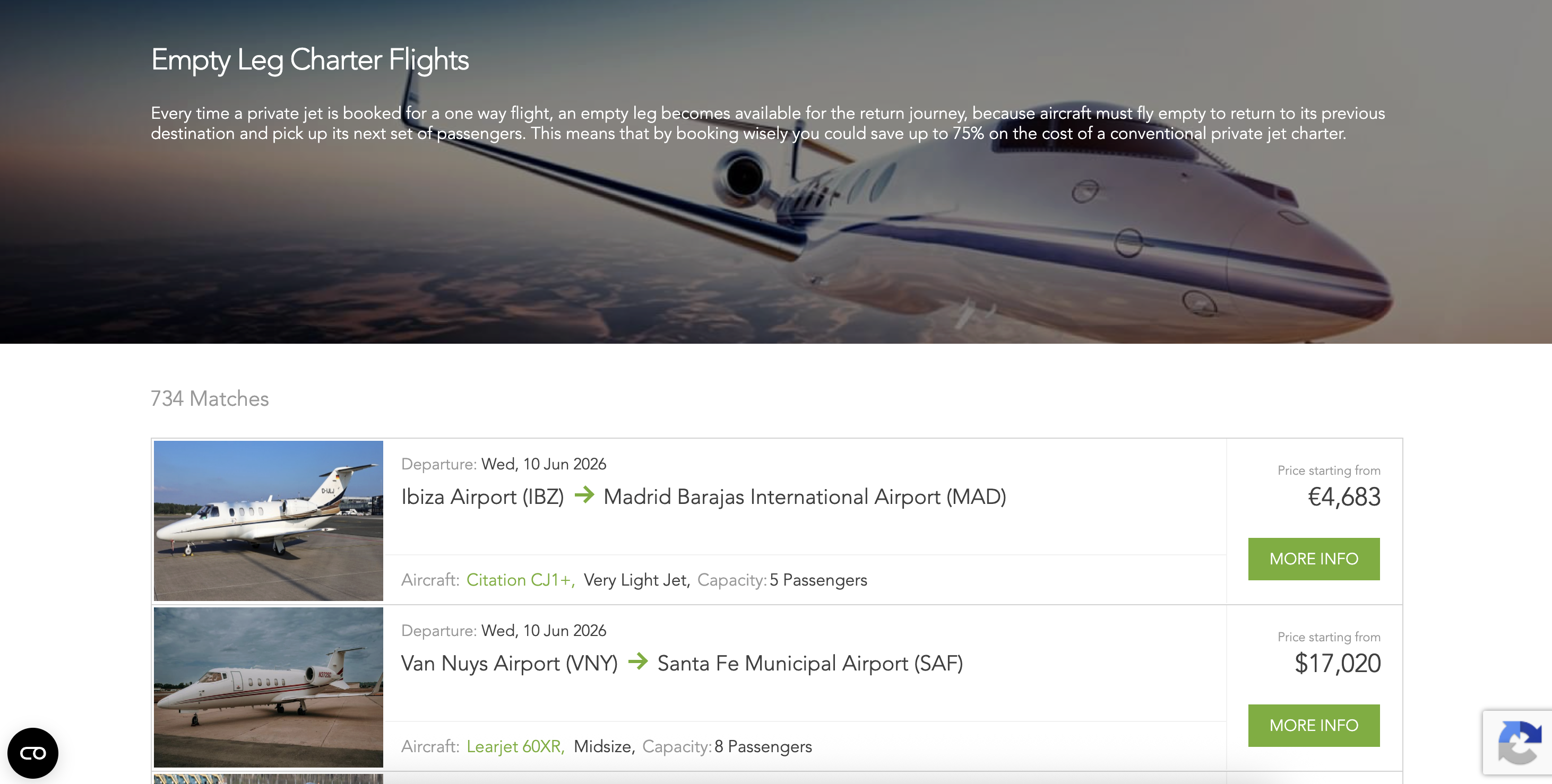
SkyAccess: Aggregates thousands of empty leg flights from certified operators worldwide, making it easy to search by route, date, and aircraft type. The platform provides transparent pricing, real-time availability, and does not require a membership to browse or book available flights.
AceJet: Monitors more than 150 private jet operators and continuously updates its database with newly available empty legs. Travelers can search by airport, route, aircraft type, or price, and create instant alerts to be notified when flights matching their preferences become available.