
Private vs Commercial. Which is safer, and why we fear flying more than driving?
Apr 21, 2026Commercial air travel dates back just over a century. From its very modest beginnings, commercial aviation has expanded dramatically, yet remarkably the accident rate has plummeted over time. Although, a question lingers. Why do more and more people fear flying though? Let's take a look.
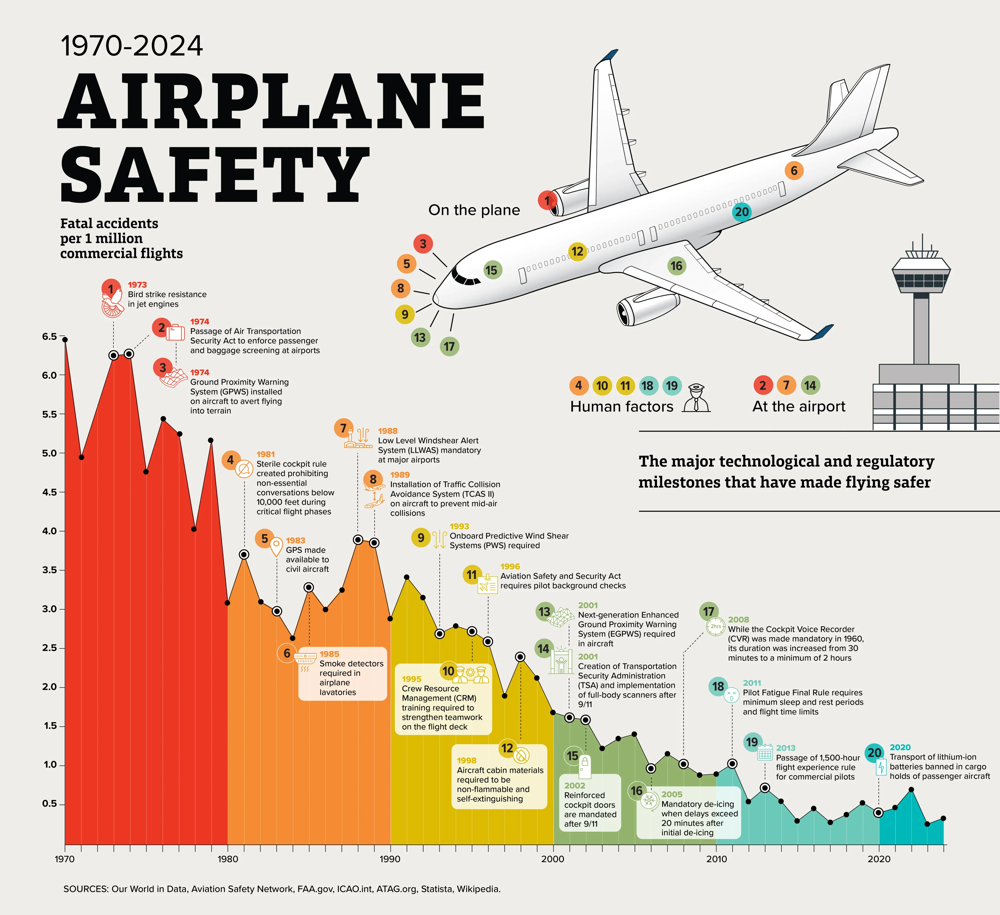
Figure: Fatal commercial airline accidents per 1 million flights have fallen quite a bit. In the 70s there were roughly 6 fatal crashes per one million flights. By the 2010s, that number fell below 1 per one million flights. Even more recent data confirm this decline. IATA reports a rate of only 0.8 per million flights in 2023, one of the lowest ever recorded.
"You’d have to fly every day for over 100,000 years before you'd find yourself in a fatal air accident."
Over the decades, global accident rates have trended decisively downward. For example, aviation analysts note a roughly halving of risk every 10 years.. MIT’s Arnold Barnett, a noted safety expert, has documented this decline. His team found passenger fatality risk per boarding fell from about 1 in 350,000 in the 1960s to roughly 1 in 13.7 million between 2018 and 2022. In practical terms, Barnett famously observed that at today’s rates you’d have to fly every day for over 100,000 years before you'd find yourself in a fatal air accident. By contrast, car travel is far more dangerous on a per-trip basis. These figures are borne out by industry statistics: for instance, in 2021 commercial airlines had only 0.133 accidents per 100,000 flight-hours (essentially zero fatal accidents) compared to 0.26 per 100,000 for corporate executive jets.
Why We Fear Flying More Than Driving Then?
This safety record would logically make people feel more afraid of driving than flying, yet psychology shows the opposite is true. Surveys indicate up to 40% of adults experience significant “flying-related anxiety,” whereas only about 10% have a serious fear of driving. Common reasons include:
- Fear of heights and loss of control. Flying involves being high above ground and entrusting one’s life to pilots. Evolutionarily, humans developed a strong fear of heights (falling off cliffs), whereas traveling fast on land was unfamiliar and not wired into our instincts. In practice, passengers often fixate on turbulence or imagine catastrophic failure, even though modern jets are over-engineered for safety.
- Perception of vulnerability. In a car we feel “in control,” but on a plane the decision and controls are out of sight. This lack of control can trigger anxiety: as one psychologist notes, flying is an “unnatural environment” where someone else is at the controls, which can make panicked “what-ifs” creep in. In contrast, most people feel they can handle an emergency while driving (even if statistically they cannot).
- Media and availability bias. Plane crashes, though extremely rare, are high-profile events. When a crash occurs, it dominates news cycles worldwide. This availability bias makes flying seem riskier than it is. Countless minor car accidents happen daily with little notice, so we underestimate driving risk.
- Sensory triggers. Sounds (whirring engines, cabin noises) and sensations (turbulence, takeoff/ landing pressure) aboard a plane can frighten nervous flyers, who may interpret them as signs of danger (even though they’re normal operations). In short, emotional and cognitive factors such as fear of heights, fear of loss of control, and sensational coverage of rare crashes, all combine to make flying feel scarier than daily driving, despite the opposite being true statistically.
How to Overcome Fear of Flying
Fortunately, there are many proven strategies to help anxious travelers become calmer and more confident:
- Education and Courses. Airlines and specialist groups offer “fear of flying” courses. For example, British Airways’ “Flying With Confidence” program is a one-day workshop led by pilots, cabin crew, and psychologists, culminating in a short demonstration flight. These sessions teach participants how aircraft work, explain safety protocols, and allow Q&A with pilots and crew. Learning the facts (like FAA data showing your crash risk is on the order of 1 in 11 million ) can dramatically reduce anxiety.
- Simulator or Training Center Visits. Some airlines have training facilities or simulators. As one traveler reported, visiting Icelandair’s training center and seeing the exact cockpit procedures and safety checks “helped quell my fears” by demystifying the experience. Even brief exposure to real aircraft or mock cockpits can make flying feel more familiar.
- Pilot Meet-and-Greets. If possible, arranging a pre-flight chat with the pilot or a cockpit visit (when rules allow) can reassure nervous flyers. Seeing the professionalism and calm of the flight crew firsthand helps passengers trust in the team’s expertise.
- Cognitive Techniques. Simple tools like deep breathing and mindfulness help manage panic, with slow, deep breaths counteracting the fight-or-flight response. Progressive muscle relaxation and focused grounding (e.g. counting objects or describing the cabin) can also calm nerves.
- Distraction and Comfort Items. Passengers are encouraged to pack familiar comfort items such as noise cancelling headphones, music playlists, books or movies, and snacks. Keeping the mind occupied (journaling, puzzles, games) diverts focus from anxiety. Some airlines even offer amenities like an inflight library or entertainment choices to engage nervous flyers.
- Professional Help. If anxiety is severe, cognitive-behavioral therapy (CBT) and even virtual reality exposure therapy have been effective. Some charter companies partner with medical organizations (e.g. VistaJet’s partnership with MedAire) to provide or arrange specialized fear-of-flying programs
Private Jets vs. Commercial Airliners: Safety Comparison
A common question is whether private jets are “safer” than big airlines. The data show that scheduled commercial airlines are at least as safe, if not safer, than private/corporate jets. In 2021 the NTSB reported about 0.26 accidents per 100,000 flight-hours for executive business jets (with zero fatal accidents that year). The National Safety Council gives a slightly higher rate (0.76 per 100,000 hours) for on-demand charter flights. By contrast, major airlines in the U.S. (FAA Part 121 carriers) had only 0.133 accidents per 100,000 hours in 2021, or roughly half the rate of executive jets, and in 2023 no fatal airline accidents at all were recorded.
Several factors explain this: scheduled airlines operate under the strictest oversight (rigorous pilot training, strict duty/rest regulations, and standardized maintenance checks). Private flights (FAA Part 91) often have lighter regulation (no FAA duty limits, sometimes smaller crews). High-end private operators do adopt stringent safety systems (ARGUS or Wyvern ratings, SMS programs), but in general the largest airlines have extremely robust safety cultures. In practical terms, although both modes are safe, airline flying is statistically safer per mile or per flight. For instance, one analysis notes that flying a single journey is about 95 times safer than driving the same distance, or equivalently, today’s fatality risk in commercial aviation is comparable to driving only a few miles on the highway.
Helping Anxious Flyers: Advice for Charter Brokers
Private jet charter brokers often encounter clients uneasy about flying. Brokers can take several steps to reassure nervous flyers:
- Emphasize the Safety Record: Share hard data: for example, the FAA notes that the chance of a plane accident is on the order of 1 in 11 million . Point out that private jets operate well within the same safety framework (trained pilots, inspected aircraft) and that large charter providers (NetJets, Wheels Up, etc.) have strong safety records. Stress that every commercial flight is the product of millions of safe hours of regulation-driven practice and technology.
- Provide Education: Offer educational resources: explain how modern jets have redundant systems, computer-managed controls, and undergo rigorous maintenance. Some brokers go further by partnering with fear-of-flying programs (e.g. arranging CBT workshops or simulator sessions for clients). Simply giving a client an overview of what to expect in flight, such as explaining what causes normal noises or turbulence, can demystify the experience.
- Facilitate Personal Connections: Encourage the client to meet the pilot and cabin crew before the flight. A friendly “meet & greet” session or a quick tour of the aircraft (subject to policy) lets the flyer see firsthand the professional who will be flying them. This builds trust and reduces the sense of the unknown.
- Tailor the Flight Experience: When possible, select jets known for smooth rides (larger cabin jets encounter less turbulence) and comfortable interiors. Suggest booking at times with stable weather or direct routing to minimize stress. Remind clients about comfort measures: encourage them to hydrate, bring blankets or pillows, and wear comfortable clothing.
- Offer Coping Tools: Remind passengers of simple techniques: taking deep breaths, focusing on the horizon if feeling uneasy, and using personal entertainment. Some brokers even have noise cancelling headphones or apps on hand. For clients with severe anxiety, recommend professional help such as therapy or medication ahead of the trip.
By combining factual reassurance with empathy and preparation, a charter broker can greatly ease a client’s flying anxiety. As one private-aviation expert puts it, cultivating confidence and showing that “experts have trained long years to keep you safe”, goes a long way toward turning fearful flights into routine travel.